
FOnline Content Showcase
A standalone, presentation-focused FOnline project that demonstrates the content pipeline without depending on Last Frontier, TLA, or another game.
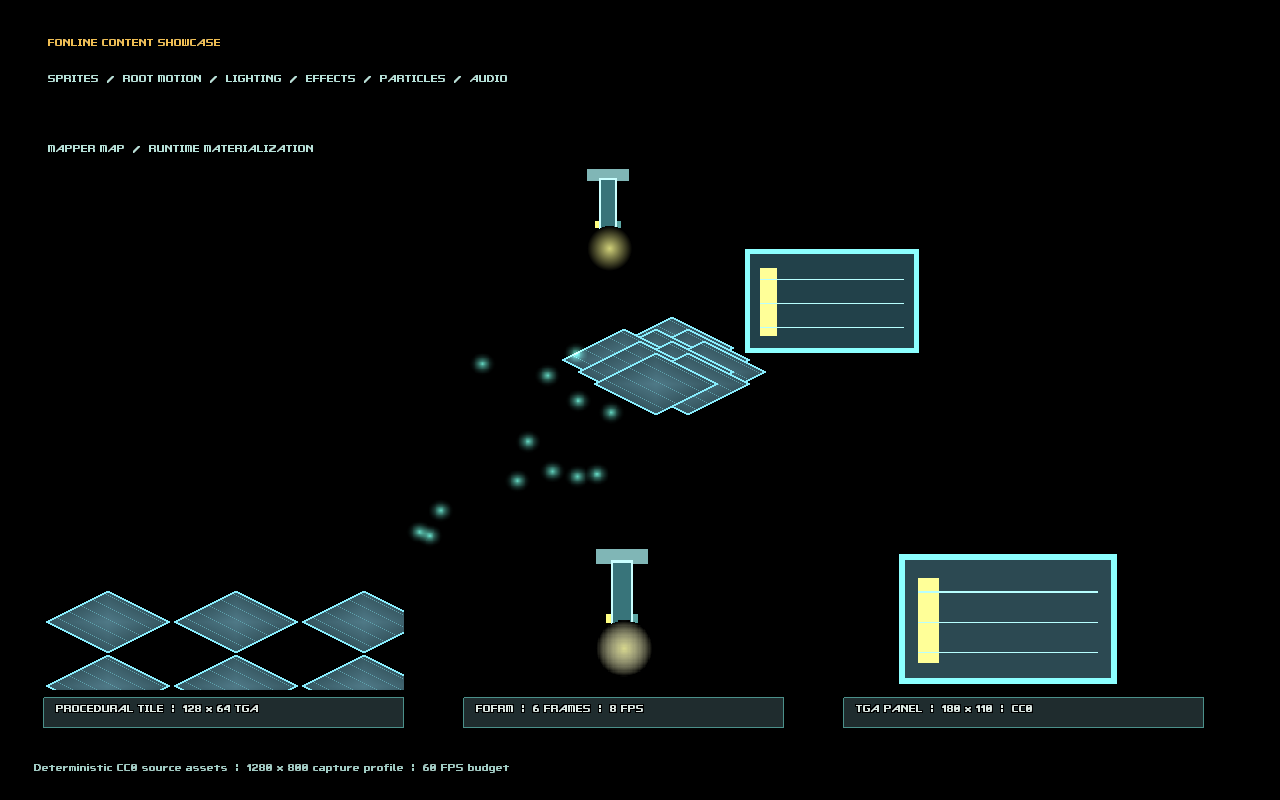
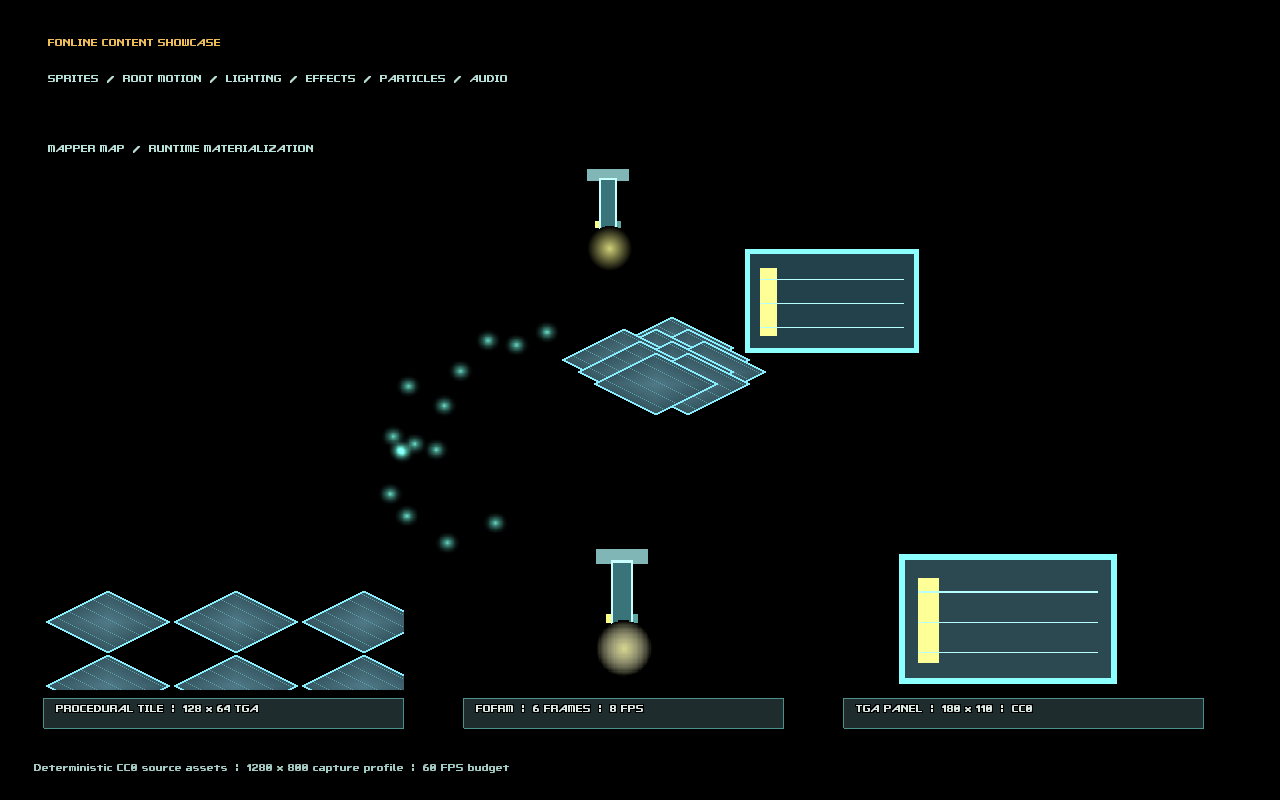
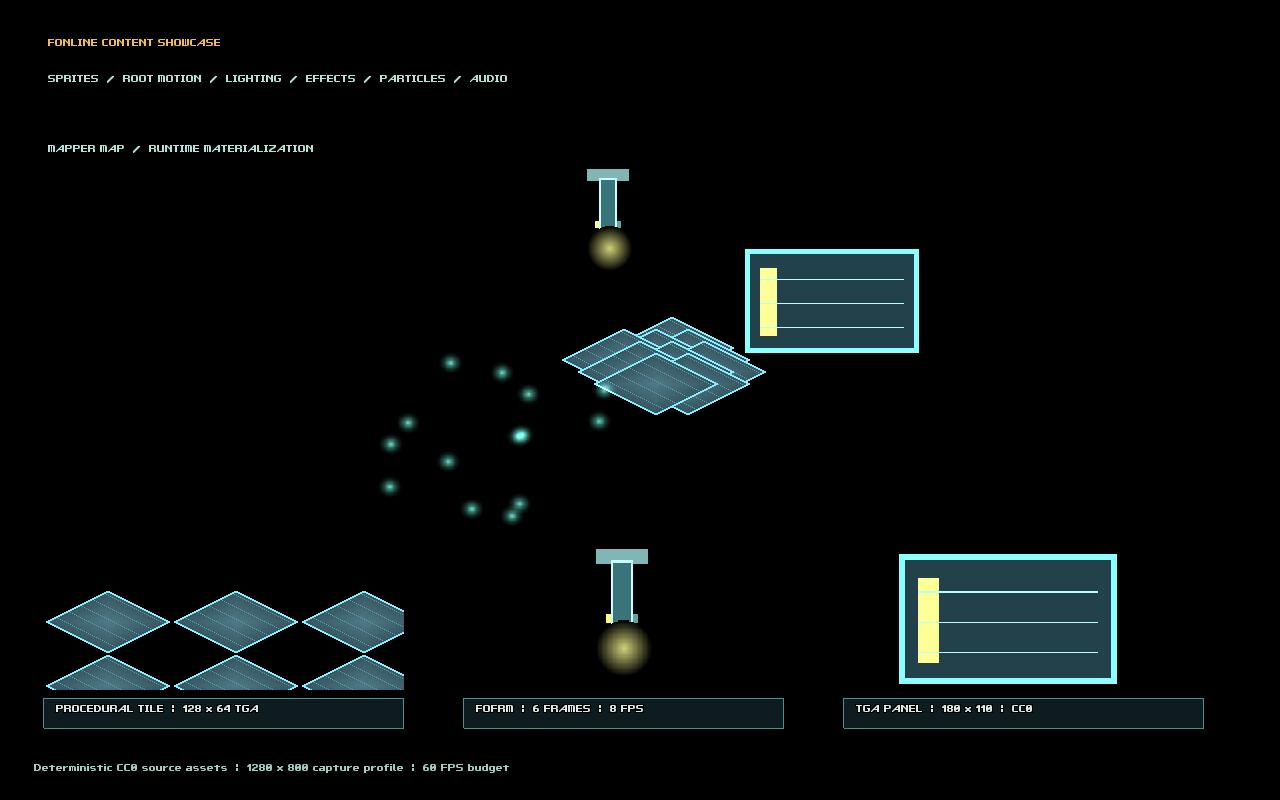
The checked project covers:
- generated TGA source images and a six-frame FOFRM animation;
- authored
NextX/NextYroot-motion metadata; - a static light source and a custom additive
.fofxeffect; - a bounded SPARK particle system and short WAV effect;
- a source
.fomapwith explicit placement identifiers; - English and Russian prototype text;
- headless source, content, and client/server lifecycle checks;
- a visible Direct3D capture with machine-checked composition regions;
- native Windows/Linux presets, an Xvfb/Mesa OpenGL capture lane, plus WebAssembly compilation, packaging, and browser runtime lanes;
- machine-readable asset rights, performance budgets, and capture provenance.
This is a rendering and authoring example, not a gameplay starter. Begin with
MinimalProject and
MinimalMultiplayer when learning the
project lifecycle or client/server interaction.
Prerequisites
- CMake 3.22 or newer;
- Python 3;
- Node.js 20 or newer and the Emscripten SDK for Web runtime validation;
- Visual Studio with C++ support on Windows, or GCC and Ninja Multi-Config on Linux;
- Xvfb, Xauth, and Mesa software rendering packages for a Linux reference capture;
- an Engine checkout available at
Engine/.
For a standalone checkout, initialize the exact Engine submodule recorded by the repository. From the Engine source tree, the local development fixture may instead use a junction or symbolic link from this directory back to the Engine root.
Validate the native project
Windows:
python validate.py
Linux:
python3 validate.py
The validator checks deterministic source assets and their SHA-256 records,
regenerates and checks the complete .fomain, configures the host preset,
bakes all resources, builds the client and server, runs an isolated content
test, and completes a real headless client/server session. The runtime session
loads the TGA, FOFRM, SPARK, effect, and WAV resources before it may pass.
Produce the reference capture
On Windows after configuration:
cmake --build --preset windows-capture
On Linux after configuration, run the visible client inside an X11 display. The required workflow installs the same pinned package group and forces software Mesa for reproducibility:
LIBGL_ALWAYS_SOFTWARE=1 SDL_VIDEODRIVER=x11 \
  xvfb-run --auto-servernum --server-args="-screen 0 1280x800x24" \
  cmake --build --preset linux-capture
The target starts a real Direct3D 11 or OpenGL client at 1280 x 800 and records
twelve warm capture samples. capture_showcase.py rejects torn or incomplete samples
unless the header, runtime map, source gallery, and provenance footer are all
present, then stores the strongest complete frame in the backend-specific path
under captures/. The capture contract records the Engine
revision, source digest, selected sample, image hash, viewport, backend, date,
pixel evidence, and the GitHub run identity when it executes in CI.
The checked Windows Direct3D 11 and Chromium WebGL 2 images are local evidence.
The checked Linux OpenGL image is retained CI evidence from
cvet/fonline-content-showcase run 30937990249; its archive digest, image
hash, process report, exact Engine pin, and pixel regions were verified before
the capture was admitted here. The Web record proves the packaged client loaded every required response,
connected to the native server, reached resources_loaded and world_ready,
created a 1280 x 800 WebGL 2 drawing buffer, and passed the same pixel-region
checks as the native captures. The required linux-showcase-capture job owns
the reproducible software-Mesa route and immutable workflow artifact; rerun it
whenever a recapture trigger changes the checked evidence.
Validate the Web build
Activate the Emscripten SDK and expose its root as FO_EMSDK, then run:
python3 validate.py --web
The Web lane validates the authored-source contract, configures with the Engine Emscripten toolchain, builds the browser client, and checks for nonempty JavaScript and WebAssembly delivery artifacts. It is the fast compile-only gate; it does not claim package or pixel evidence.
Build and inspect the complete delivery package with native-host baking:
python3 validate.py --web-package
This route force-bakes with the native Windows/Linux baker, builds the Web
client, creates the raw and ZIP payloads, and verifies the exact six-file
inventory, WebAssembly magic, Resources.data, LZ4 loader, generated Web page,
archive parity, and CRC. The explicit FO_EMSDK environment variable takes
precedence over any SDK inferred from the Engine workspace.
Install the example-owned pinned browser dependency once, then run the complete non-mutating browser check:
cd WebTests
npm ci
npx playwright install chromium
cd ..
python3 validate.py --web-runtime
The runtime route includes the package route, starts the native headless server
and packaged HTTP server, observes all required HTTP responses and client/server
markers, requires a WebGL 2 context, rejects console, page, network, Engine, and
script failures, and checks the compositor screenshot with the native pixel
contract. Runtime output stays under Workspace/; maintainers use
capture_showcase_web.py --update-contract --output captures/web-webgl2.png
only when intentionally replacing the checked reference.
Source map
| Path | Ownership |
|---|---|
ShowcaseAssets/Showcase/ |
Redistributable image, animation, effect, particle, and audio sources |
Content/ShowcaseContent.fopro |
Critter, item, light, particle, and location prototypes plus EN/RU text |
Maps/ShowcaseMap.fomap |
Compact gallery layout with stable placement identifiers |
Scripts/Showcase.fos |
Login, lifecycle checks, resource loading, visible composition, and capture sampling |
assets/provenance.json |
Exact source path, license, origin, and SHA-256 for every distributed asset |
quality/performance-budget.json |
Asset-size, map-density, particle, audio, viewport, and FPS limits |
captures/capture-contract.json |
Per-backend evidence state and recapture triggers |
showcase-web-package.json / showcase-web-runtime.json |
Exact packaged payload, browser, network, marker, viewport, and failure contracts |
WebTests/ |
Example-owned, lock-file-pinned Playwright runtime |
generate_assets.py |
Pure-standard-library deterministic TGA and WAV generation |
generate_config.py |
Full Engine-settings-derived project configuration |
Runtime resource names begin at Showcase/; ShowcaseAssets is only the
project-side data-source directory. Keeping authored input separate from
Resources-Baked, ServerResources, Cache, and PlatformBinaries prevents
local outputs from becoming accidental source.
Authoring practices demonstrated
- Keep source rights explicit. Every distributable asset is listed once with
its exact digest and is covered by
ASSET_LICENSE.md. - Keep expensive content bounded. Particle capacity, static item count, audio duration, source bytes, viewport, and target FPS are reviewed data rather than informal promises.
- Test each boundary separately. Source checks prove bytes and references; baking proves converters; content tests prove prototypes and map structure; headless smoke proves loading and lifecycle; visible captures prove pixels.
- Preserve authoring metadata. FOFRM frame timing and every
NextX/NextYvalue are checked instead of treating the descriptor as an opaque file. - Keep backend claims evidence-based. Direct3D 11 and WebGL 2 have separate checked captures; neither implies OpenGL visual acceptance.
Engine updates
An Engine revision change is a documentation-bearing change. In the same pull request:
- record the old and new exact Engine revisions;
- review the complete incoming Engine range for image, effect, particle, audio, map, renderer, screenshot, configuration, CMake, and Web changes;
- regenerate
FOnlineContentShowcase.fomainand the deterministic assets; - run native source/content/runtime checks and every affected platform lane;
- recapture each affected backend and update its evidence record;
- update this English document and
README.ru.mdwhen commands, behavior, budgets, limitations, or evidence change.
Do not refresh only hashes after a visual difference. Explain the change, review the decoded image, and retain the new capture only when the composition is intentional.
Honest limitations
- The gallery has no production authentication, persistence, combat, economy, deployment, installer, signing, or rollback policy.
- The headless lane confirms that audio is accepted, not that it is audible or mixed correctly on a real device.
- The sample demonstrates 2D content; a 3D model was intentionally omitted to keep source and rights review compact.
- FOFRM root-motion metadata affects presentation frames here and does not move an authoritative game entity.
- Public repository visibility, immutable tags, hosted Web output, and Linux OpenGL release evidence remain owner-gated publication work.